Kalshi: Building Exchange Infrastructure for a Probabilistic World
How Kalshi is building regulated prediction markets into financial infrastructure and a real-time probability layer.

TL;DR
- Prediction markets are shifting from a niche product into a mainstream probability layer, with tradable prices that update in real time and can complement polls, research, and proxy assets.
- The 2024 US election was the breakout catalyst, concentrating attention and liquidity and pushing prediction markets into mainstream media and public conversation.
- Kalshi is trying to win by being the regulated US leader, using sports for repeat engagement, expanding into macro and real-world markets, and scaling through partnerships.
- The long-term battle is Kalshi’s regulated, partner-embedded model versus Polymarket’s crypto-native liquidity flywheel, with winners defined by trust, distribution, and market quality.
The thesis & The opportunity
Wealt believes the next phase of financial infrastructure will include a real-time probability layer, a market-derived signal for uncertainty that sits alongside prices, polls, and breaking news across mainstream platforms. This is not a speculative product category. It is a structural gap in how markets currently process discrete, event-driven risk. Years of trading in financial markets taught us that hedging an election outcome means using equities as a proxy. Hedging a rate decision means relying on instruments that move for dozens of unrelated reasons. While event contracts tie payouts directly to the outcome itself, they produce cleaner hedges, clearer signals, and a more honest price. The binary payout structure avoids the Greeks, implied vol, and time decay that make options-based event hedging operationally complex, and the fixed $1 vs $0 payoff allows price to translate directly into implied probability, making it a credible reference for investors, enterprises, and media alike.
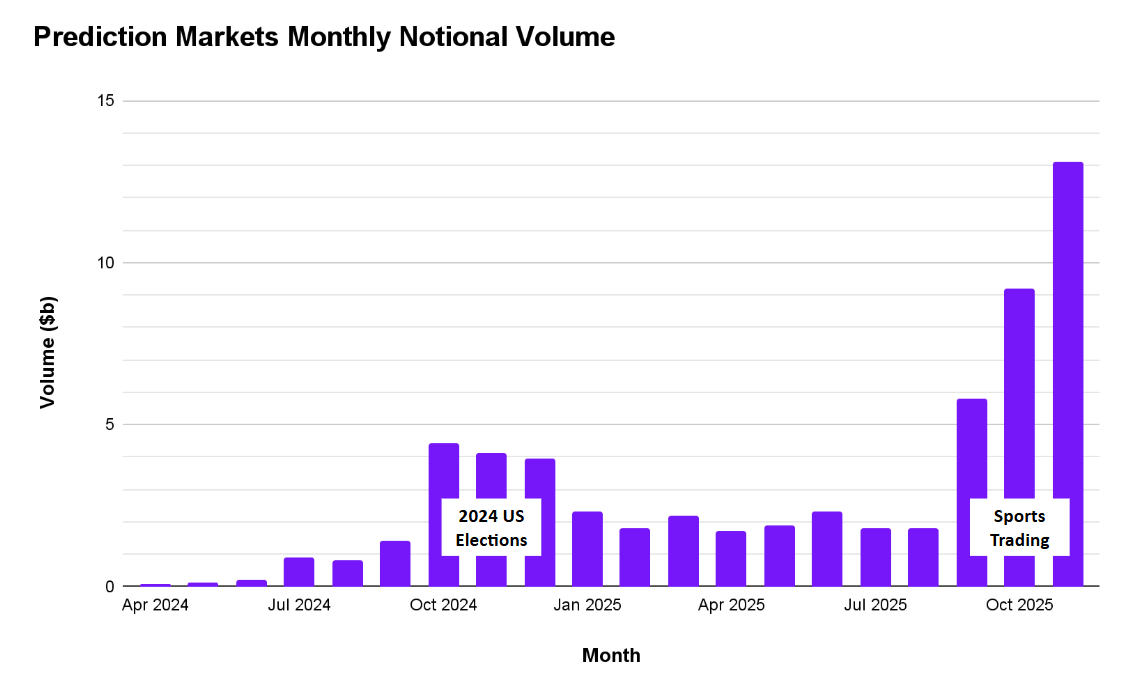
The evidence that this transition is underway is substantial. Prediction markets have grown approximately 130x, from under $100M in monthly notional volume in early 2024 to over $13B by November 2025, with 43M+ monthly transactions and 600K+ monthly users. Kalshi's weekly trading volume now exceeds $1B, up ~1,000% versus 2024, across sports, macro, politics, culture, and climate markets. It all started when the 2024 US election drew global attention to a single tradeable event, and since then, the category has moved beyond politics into higher-frequency markets like sports, macro, and culture. Kalshi sits at the centre of this transition. It is building a regulated event contracts exchange designed to be embedded into other platforms, pairing consumer distribution with an institutional liquidity and market integrity layer.
Prediction markets: Unlike gambling
At a basic level, prediction markets let users trade simple contracts that pay out based on a real-world outcome. Prices move between $0.01 and $0.99 as a live probability, and because you can enter and exit before resolution, the product behaves more like an exchange than a one-off bet. Kalshi is built as a central limit order book where price discovery comes from matching buyers and sellers, with the platform earning transaction fees rather than setting odds.
With probabilities updating in real time, they become a live measure of consensus, information flow, and market positioning. This is why prediction markets can sit next to polls, research, and proxy assets as an additional layer of analysis or an accurate source of real-time data. This is why media and platforms increasingly want to embed “odds” as a probability ticker rather than treat the product as another form of gambling entertainment.
A catalyst: The 2024 US elections
Prediction markets have existed for years, but the 2024 US election was the moment they broke into the mainstream. A single, time-boxed event with nonstop news flow created the perfect environment for live probabilities, pulling in retail and institutional users, media attention, and liquidity at a scale the category had not seen before. Just as importantly, it gave the public a simple, intuitive way to trade on uncertainty and profit from their own beliefs, creating a continuously updated price that everyone could reference as the race evolved.
By November 4, 2024, it was reported that Polymarket's presidential markets had roughly $3.1B in trading volume, while Kalshi had reached about $197M in its presidential market, plus $33.8M in its electoral college margin market. Kalshi also benefited from the October 2, 2024, appeals court decision that allowed it to list certain election-related contracts, reinforcing the legitimacy of regulated event markets at exactly the moment public interest peaked.
From curiosity to infrastructure
The biggest misconception is that prediction markets are just gambling. The more interesting path is for them to become a probability layer embedded across the economy.
- For consumers, they offer a repeatable way to express a view with real stakes and track how odds move as news breaks.
- For investors, they provide a live consensus metric around key catalysts.
- For media, they serve as a probability ticker, turning narrative into numbers.
- For enterprises and the public sector, they can become a decision-support signal that quantifies uncertainty and captures public consensus in real time.
Event-level hedging is a big part of why prediction markets can become genuinely useful, letting you hedge the outcome you actually care about rather than relying on proxy assets with messy correlations and basis risk. Today, if you want protection against a discrete catalyst, you often use stand-ins like equities for election outcomes, oil for geopolitical shocks, or rates for policy decisions, but those markets can move for dozens of unrelated reasons. Event contracts tie payout directly to the event itself, so the hedge is cleaner, more targeted, easier to size in dollar terms, and as liquidity improves, these contracts become usable at scale while also producing a real-time probability signal.
Kalshi: From theory to practice
Instead of optimising for speed or permissionless market creation, Kalshi has positioned itself as the regulated US leader, operating within the derivatives framework to scale nationwide, partner with large distribution platforms, and build long-term credibility with institutions. In a category where trust, settlement, and legality are constant friction points, this is a real competitive advantage: being inside the regulated perimeter makes Kalshi easier to embed, defend, and replicate.
That positioning shapes what Kalshi focuses on. The company has deliberately built around high-frequency categories that create habit and liquidity, with sports emerging as the dominant repeat-use engine and a key moat, accounting for roughly 85% of 2025 notional volume. The logic is to win frequency first, so markets stay liquid and usable day-to-day, then widen relevance into macro and real-world markets where probabilities can become a broader information layer rather than a one-off entertainment product.
Underneath the consumer experience, Kalshi is also building the institutional layer that makes retail scale sustainable, which is the second major advantage. Programmatic access and a formal market-maker ecosystem tighten spreads and deepen order books, improving execution quality and retention, with Susquehanna joining as a dedicated institutional market maker to enhance market quality. Combined with partner-led distribution, such as Robinhood and Coinbase rolling out Kalshi-powered prediction markets, Kalshi is building a flywheel that competitors struggle to match: regulated status unlocks partnerships, partnerships drive flow, and institutional liquidity improves market quality, which in turn supports more partners and repeat usage. The endgame is to become the default US venue for event contracts, and the probability infrastructure that other platforms can plug into with confidence.
.png)
Market design: Kalshi vs Polymarket
Kalshi and Polymarket are the two clear leaders, but they are scaling through fundamentally different models. Kalshi is building a regulated, partner-embedded US exchange, optimising for distribution, credibility, and institutional readiness. Polymarket is a crypto-native marketplace built for speed and global participation, where liquidity and cultural relevance around major events have been the primary drivers of growth. The result is two distinct paths to becoming the default probability layer.
.png)
Kalshi’s US retail access and partner distribution have made sports the dominant repeat-use wedge, accounting for roughly 85% of its 2025 notional volume, while Polymarket’s crypto-native user base has historically concentrated activity in politics and crypto, alongside a meaningful sports footprint. In 2025, Polymarket’s mix is estimated at around 39% sports, 34% politics, and 18% crypto, which reflects where it has been most culturally noticeable. Kalshi, however, has been steadily taking share of combined notional volume versus Polymarket since 2024, moving from a minority position to roughly half or more by late 2025 as distribution and liquidity scaled.
.png)
Strategically, the battle is now about what becomes the gating factor as prediction markets go mainstream. Even as Polymarket moves into a regulated structure, Kalshi still stands out because it has been operating within the US regulatory perimeter for longer and has oriented the entire business around partner-safe distribution. If distribution partners, regulators, and institutions increasingly dictate the rules, Kalshi’s regulated posture and institutional layer create a durable advantage by keeping spreads tight and market integrity high as scale increases.
Measuring the Future
Prediction markets are moving from a destination product to an embedded layer within mainstream apps, where probabilities are consumed alongside prices, polls, and breaking news. The Super Bowl showed how quickly this can scale, with Kalshi reporting over $1B in trading volume on Super Bowl Sunday and a sharp increase in mainstream participation, helping pull prediction markets further into popular culture rather than just politics. Kalshi also reached unicorn status in 2025, reflecting how quickly the market has started to price in the category’s potential.
The next phase should be less about one-off spikes and more about repeatable, always-on markets with tighter liquidity, broader categories, and real utility such as event-level hedging. In that world, the winners will be defined by trust and distribution, and Kalshi is well-positioned to benefit as partners seek a regulated, integration-ready venue.
Forecast accuracy as the probability signal
.png)
Prediction markets are only as valuable as their probability is credible. Brier score measures forecast accuracy across resolved contracts; lower is better, and Kalshi's distribution is tighter than any major competitor, with most markets falling well below 0.10. Polymarket's wider distribution reflects its permissionless model, where lower-quality listings pull the average up. This matters because media and institutional partners will only embed probability data from a source they can defend analytically, and because the event-level hedging use case depends on the signal being credible far from resolution, not just near it. Kalshi's Brier scores remain low even 300+ days before resolution, a period when institutional hedging becomes practically useful. Permissioned market creation, where all listings go through internal research review, is the structural mechanism that sustains this advantage as volume scales.
The Wealt take
Wealt's thesis at the top of this piece was that regulated event contracts are becoming permanent financial infrastructure, and that the platform best positioned to own that layer in the US is the one with the regulatory moat, the distribution partnerships, and the institutional liquidity depth to compound each advantage off the others. Everything above confirms that the thesis is playing out. Kalshi crossed into profitability in 2025 on 5,947% revenue growth, backed by some of the most credible institutional investors in technology, Paradigm, Sequoia, a16z, and General Catalyst, who have collectively re-priced the business twice in two months. This is a key testament to the company’s adoption of a fast-growing landscape of regulated probabilistic markets. The competitive position is widening. The distribution flywheel is accelerating. The regulatory framework is progressively clarifying in Kalshi's favour.
For Wealt investors, this is access to a late-stage private position in the category-defining prediction markets platform at a stage that would ordinarily require direct relationships with the company's lead institutional investors. Wealt provides structured secondary access through terms and minimum sizes appropriate for qualified individual investors, offering exposure to the pre-public phase of a business whose operating leverage, distribution scale, and regulatory standing are all compounding at the same time.
At Wealt, we run independent research on companies shaping these transitions and provide our community access to opportunities that have traditionally been institution-only. If you would like to explore our portfolio companies or gain access to our strategy, you can apply to join the Wealt platform.
👉 Download the Wealt App on App Store or Google Play.
All investments carry risk, including the possible loss of capital, and past performance is not a guide to future returns. This opportunity is suitable only for sophisticated investors who understand and can bear those risks.
.jpg)
Subcsribe to our weekly newsletter